Harvest King: Farm TD Strategy
- 4.4
- Rating
- 1.00M
- Installs
- Free
- Price

 Analysis by App-foxy
Harvest King: Farm TD Strategy caught my attention because it puts a cheerful farming theme around a tower-defense puzzle instead of relying on a darker battlefield setting. After spending time with it, I found a game built around a simple question: how efficiently can I combine vegetables before the next enemy wave becomes too difficult to handle? That idea is easy to understand, but the best moments come from deciding when to merge, when to hold back, and when a seemingly small upgrade is worth protecting.
It is a free puzzle game from Homa, aimed at players aged 10 and over. The store presents it as an idle tower-defense experience, but I would describe it more precisely as a light strategy game with merge decisions at its center. The farming presentation makes the first few minutes approachable, while the wave structure gives the short sessions a clear purpose. I could pick it up for a quick break, make a few decisions, and leave without needing a long uninterrupted play session.
The game has already passed one million installs and holds a 4.4 average from about sixteen thousand ratings, which fits my impression of a polished, accessible mobile release rather than an experimental puzzle. It is free to download, though optional purchases range from $0.99 to $99.99 per item. That pricing range is worth remembering before settling into longer sessions, especially if you are sensitive to games that repeatedly place upgrades or boosts near the main play loop.
You May Also Like

 Blood Strike: 2.5 Anniversary
Blood Strike’s Loadouts Turn Every Drop Into a Tactical Gamble
A close look at Blood Strike’s custom loadouts: how fast access to signature weapons reshapes its battle royale rhythm, rewards preparation, and narrows the gap between fights.

 Pandora - Music & Podcasts
Pandora’s Music Is Easy to Start, but Harder to Recover
Pandora’s strength is its low-effort path from a seed to a station. Its weak spot is how much confidence it asks you to place in connection, setup, and quiet recovery.

 8 Ball Pool
 Is Built on Rivalries, Rematches, and Routine
A close look at the rivalries, rematches, shared routines, and unanswered safety questions that turn a quick pool match into a persistent mobile community.

 Samsung Music
’s Quiet Strength Is Playing What You Already Own
Its reach comes less from spectacle than from dependable access to a personal library. That simplicity is both the app’s strongest retention engine and its ceiling.

 AccuWeather: Weather Radar
AccuWeather Review: A Quick, Clear Forecast for Everyday Decisions
For everyday plans, the best forecast is the one you can understand quickly. AccuWeather makes rain timing, radar, and local conditions easy to act on, with a few trade-offs.

 Hill Climb Racing
Why Hill Climb Racing Still Turns Crashes Into One More Run
A tiny car, a bumpy hill and one more upgrade: Hill Climb Racing keeps resurfacing because its simple chaos makes every near-miss feel personal.
More From Our News Desk



A bright farm setting with more tactical pressure than it first suggests
I found the farm theme inviting, but the real appeal is how it turns a friendly-looking board into a series of small defensive choices. In this section, I’ll look at how the setting and pacing help the game feel approachable without removing the need to plan. That contrast also points to the tactical decisions that matter most.
The first impression is friendly, quick, and deliberately uncomplicated
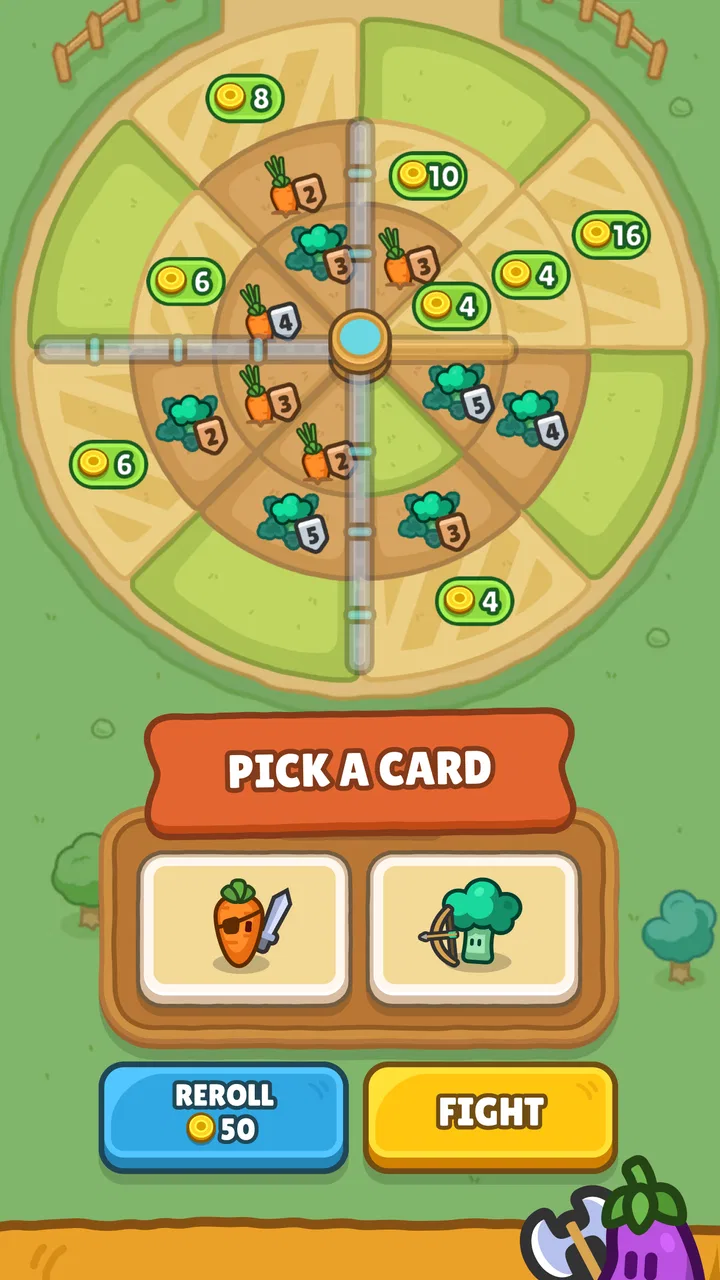
The opening presentation does a good job of lowering the barrier to entry. Vegetables are easier to read at a glance than military units or abstract geometric pieces, and the farm setting gives the board an immediately recognizable identity. I never felt that I needed to study a dense interface before making my first move. The overall visual language says “casual game,” but the incoming waves quietly add urgency.
That contrast is important. The cheerful crops and playful setting make failure feel less punishing, yet the defense structure still asks me to pay attention. If I merge without considering what is approaching, the friendly appearance does not save the run. The game works best when it lets the art make the experience inviting while the puzzle layer supplies the concentration.
The early pacing is particularly suitable for people who do not normally play tower defense. Instead of throwing a complicated battlefield at me, it presents the central action in a form I could understand through use. I learned more from watching the result of a merge than I would have from a long explanation. That makes it a comfortable recommendation for someone who enjoys match-and-merge games but wants a little more pressure than a purely decorative puzzle provides.
There is also a useful mental shift in the way the farm theme frames progress. I am not simply clearing identical pieces for points; I am preparing a small defense against a sequence of threats. That gives each merge a practical meaning. A stronger vegetable is not only a better-looking item on the board; it represents more confidence in the next wave. This connection between visual theme and mechanical purpose is one of the game’s clearest strengths.
The world communicates through color, shape, and readable movement
Harvest King does not need a large narrative to establish its setting. The farm identity comes through the crops, the playful presentation, and the idea of protecting a harvest rather than conquering a distant battlefield. I appreciate that restraint. The game’s world exists mainly to support the puzzle, so it does not interrupt the rhythm with story scenes that would feel disconnected from the short-session format.
The art direction also helps with quick decisions. In a merge-defense game, visual confusion can become a real mechanical problem: if two units look too similar, I may spend time checking the board instead of planning. Here, the crop-based theme gives the pieces a consistent visual vocabulary. I can approach the board as a collection of growing resources, which makes the upgrade path easier to follow mentally.
That simplicity has a trade-off. Players looking for a rich fantasy world, detailed character animation, or a story that develops between battles may find the setting lightweight. The farm is a mood and a framework rather than a deep fictional place. I did not view that as a flaw for the intended format, but it does limit the emotional range. The game wants me to solve the next defense problem, not become attached to a cast of characters.
A practical tip is to judge the board by function rather than by the apparent value of individual vegetables. The most attractive or recently upgraded piece is not automatically the best one to prioritize. I found it more useful to look at the whole arrangement and ask which merge improves coverage or timing for the next wave. That habit matters more than chasing every available combination immediately.
Sound and rhythm keep the farm from feeling static
The audio presentation supports the game’s light tone rather than trying to dominate it. In my experience, that is the right choice for an idle-leaning puzzle. The visual board remains the main source of information, while sound helps mark actions and gives the waves a sense of arrival. The result is a playable mood that feels relaxed between threats but more focused when the defense is underway.
Pacing does much of the work that a larger soundtrack might otherwise handle. A quiet stretch gives me time to inspect the board and decide whether to merge now or wait. The approach of an enemy wave changes that mood without requiring a dramatic story beat. I begin in a planning mindset, move into a reactive phase, and then return to rebuilding. That repeating rhythm makes a short session feel complete.
This is also where the idle element can be appealing. I do not need to treat every second as an emergency, and the game can fit around ordinary interruptions. I could imagine playing it while waiting for a bus or during a short break, checking the board, making a few upgrades, and putting the phone away. The design is less suitable for someone who wants constant high-speed input, but that is not what this game appears to be chasing.
The downside of this relaxed rhythm is that experienced puzzle players may eventually want more variety in the pressure. If the wave pattern or decision structure starts to feel familiar, the farm atmosphere alone may not be enough to maintain interest. I would recommend it more strongly to players who enjoy incremental improvement and repeated optimization than to players who need dramatic surprises in every session.
Merge decisions are strongest when they serve the defense
The central mechanical fit is sensible: merging vegetables improves the tools available against enemy waves, so the puzzle action has a direct defensive consequence. I like this more than merge systems where combining objects feels detached from the rest of the game. Here, the board is not just a place to tidy up. It is a preparation space, and every decision can affect how comfortable the next attack feels.
The most useful strategy is to avoid treating every possible merge as an automatic move. A quick combination may create a stronger unit, but it can also change the balance of the board at an awkward moment. I learned to consider three things before committing: whether the next wave is close, whether the merge leaves enough useful pieces behind, and whether the upgrade solves an immediate weakness or merely looks satisfying.
This creates a nice trade-off between short-term security and long-term growth. Spending resources to stabilize the current wave can leave fewer options for the following one. Holding pieces for a larger combination can be rewarding, but it is risky if the present defense is already strained. That tension is the game’s most interesting strategic layer, and it gives the otherwise simple farm theme a little bite.
Another practical workflow is to use the calmer moments for board organization and reserve the more decisive merges for a clear purpose. I found that random combining made the field feel busy without necessarily making the defense stronger. A better approach was to identify the weakest part of the setup, prepare the necessary pieces, and merge only when the result addressed that weakness. This is a small habit, but it makes the game feel much less dependent on luck or frantic tapping.
The game is not the right choice if you want a deep, traditional tower-defense system with elaborate maps, extensive unit rosters, or highly technical placement rules. Its appeal comes from compressing defense planning into a merge-focused format. Players who prefer detailed battlefield control may be happier with a conventional tower-defense title, while players who find those games too demanding may appreciate this softer entry point.
What the free model means during everyday play
Because the game is free, it is easy to try without making a commitment. That is a genuine advantage for a casual puzzle, particularly when the core appeal depends on whether the merge-and-wave rhythm suits your habits. I would start with short sessions rather than assuming it will replace a larger strategy game. The format reveals its strengths quickly: accessible controls, a clear objective, and a farm mood that makes repeated attempts comfortable.
Optional purchases are available from $0.99 to $99.99 per item. I would approach them carefully and first see how far the free experience carries me. In a game built around gradual improvement, a purchase can be tempting when a wave exposes a weakness, but that is exactly when it is useful to pause and decide whether I am solving a strategic problem or simply trying to skip friction.
For parents, the Everyone 10+ rating makes the game a plausible choice for older children and families who want a mild strategy experience rather than an intense action title. I would still explain the purchase system before handing it over, particularly if the device allows transactions without a separate conversation. The colorful farm setting is approachable, but the presence of optional spending deserves the same attention as it would in any free mobile game.
The technical entry point is also broad: the current version is 15.0 and it runs on Android 7.1 or later. That makes it accessible to people using older Android hardware, although the actual comfort of play will still depend on the phone’s general condition and how smoothly it handles the game. I would keep expectations realistic on an aging device, especially if other apps are open in the background.
Who will enjoy the loop, and who should skip it
I think Harvest King is best for someone who likes visible progress, compact strategy decisions, and a game that can be checked in small bursts. It suits players who enjoy asking whether one more merge will improve the next wave, and it works well for people who prefer a friendly presentation over a grim combat atmosphere. The farming theme is not just decoration; it makes the upgrade process feel more playful and less intimidating.
I would also recommend it to a puzzle fan who has tried standard match games but wants consequences attached to each move. The enemy waves create a reason to plan beyond the immediate combination. That extra layer is enough to make the board feel purposeful without turning the game into a complicated spreadsheet.
I would skip it if your priority is a story-heavy farming simulator, a competitive strategy game, or a tower defense with precise control over every unit. The game’s strength is its narrow focus, and that focus means it cannot satisfy every kind of strategy player. It is also a poor fit if you dislike idle progression or become frustrated by the possibility of optional purchases influencing the pace of improvement.
Compared with ordinary merge puzzles, this one gives combinations a stronger sense of urgency because the next wave is always part of the calculation. Compared with conventional tower defense, it removes much of the detailed placement and replaces it with a more compact resource puzzle. That middle ground is where it feels most distinctive. It is neither a pure relaxation game nor a demanding tactical simulator.
The atmosphere works because the mechanics stay visible
My overall impression is that the art, setting, sound, and pacing are aligned with the actual play. The vegetables make the board friendly, the farm setting gives the defense a coherent identity, and the wave rhythm prevents the idle structure from becoming completely passive. Most importantly, the presentation does not hide the decisions. I can still see that a merge is a commitment and that a poorly timed upgrade may leave the next phase uncomfortable.
That balance is easy to get wrong. A cute theme can make a strategy game feel shallow, while a heavy defense layer can make the same theme feel irrelevant. Harvest King generally avoids both problems by keeping its ambitions modest. It wants to make planning approachable, not simulate an entire agricultural kingdom or a complex military campaign. I found that honesty refreshing.
There is still some friction in the repetition. The basic loop can become predictable for players who need constant mechanical expansion, and the free-to-play structure means I would remain alert to moments when progress feels slower than the puzzle itself deserves. Those limitations do not erase the good work in the presentation, but they affect how long I expect the game to hold my attention.
For me, the best way to play is in focused intervals: inspect the board, identify the next defensive need, make deliberate merges, and stop when the session starts to feel automatic. That approach keeps the farm mood pleasant and makes the strategy easier to appreciate. Playing while distracted can turn the game into routine tapping, which misses the small but satisfying decisions at its center.
My final take on the farm defense
Harvest King: Farm TD Strategy is a welcoming puzzle game that uses vegetables and farm imagery to soften a surprisingly thoughtful merge-and-wave loop. I enjoyed the way its bright presentation creates a calm surface while the defense structure asks me to manage timing and priorities. It is especially effective for short sessions, casual strategy practice, and players who want more consequence than a standard merge board provides.
It is not a replacement for a full tower-defense game, and I would not choose it for a deep narrative or a richly simulated farm. Its strengths are more focused: readable presentation, approachable pacing, and decisions that connect the board directly to survival against enemy waves. The free entry point makes trying it easy, while the optional purchase range means I would play at my own pace rather than assuming spending is necessary.
If that combination sounds appealing, I think it is worth giving a few sessions. Go in expecting a light strategy puzzle with a friendly agricultural mood, not an expansive farming adventure. When I played it with that expectation, the atmosphere and mechanics supported each other well, and the simple act of merging vegetables became a satisfying way to prepare for whatever arrived next.
FAQs for Harvest King: Farm TD Strategy
01What is Harvest King: Farm TD Strategy?
Harvest King: Farm TD Strategy combines farming management with tower defense gameplay. You develop your farm, collect resources, and use strategic defenses to protect your land from incoming threats. The game is designed for players who enjoy a relaxed agricultural theme but still want tactical decisions, progression systems, and increasingly challenging battles as they advance.
02How does the gameplay work in Harvest King: Farm TD Strategy?
The main gameplay loop involves improving your farm, gathering or managing resources, and preparing defensive units or structures before enemy waves arrive. Success depends on choosing suitable upgrades, placing defenses effectively, and balancing economic growth with protection. As stages become harder, simply relying on one strategy is unlikely to be enough, so planning is important.
03Is Harvest King: Farm TD Strategy free to download and play?
Harvest King: Farm TD Strategy is generally presented as a free-to-download mobile game, although availability and pricing can vary depending on whether you use Android or iOS. Like many strategy games, it may include optional in-app purchases, such as resources, boosts, or progression items. Check the store listing and purchase settings before downloading, especially if children use the device.
04Can Harvest King: Farm TD Strategy be played offline?
Offline availability may depend on the specific mode and version installed on your device. Some farming or previously loaded gameplay elements may work without a connection, while advertisements, cloud synchronization, updates, rewards, or online features can require internet access. If offline play is important to you, verify the current store description and test the game before relying on it during travel.
05Is Harvest King: Farm TD Strategy suitable for casual players?
The game can suit casual players because its farming theme and gradual progression make it approachable, while the tower defense mechanics provide additional depth for those who enjoy strategy. However, later stages may require more careful resource management, repeated attempts, and regular upgrades. Players looking for a completely passive farming experience may find the defensive challenges more demanding than expected.
Pros
- Simple tower-defense mechanics are easy to learn for newcomers.
- Farming and defense systems create a distinctive gameplay combination.
- Short sessions fit well into quick breaks or casual play.
- Progression gives players goals beyond completing individual levels.
- Colorful visuals make the farm setting approachable and easy to follow.
Cons
- Repeated enemy waves can make later stages feel predictable.
- Upgrades may require considerable grinding between challenging levels.
- The small-screen interface can feel crowded during busy attacks.
- Limited strategic variety may reduce long-term appeal for expert players.
- Performance and battery use may vary on older mobile devices.

Harvest King: Farm TD Strategy
Gallery